How to confront prejudice: A Gandhian lesson
Last week I confronted a friend about a communal post he shared on social media. I had always considered him kind and reasonable. I wondered how he could share such a post.
“It was posted in my political group. I just shared it,” he said while calmly sipping his tea.
I glanced around the cafe and asked whether he had verified the claims in the post. He said he didn’t because it came from the political group he trusted. He was not comfortable questioning the authority of the group leaders.
I lowered my voice, conscious of the couple at the next table, and pointed out how the post demonised an entire community. I shared my concern that it could snowball into a hate campaign or result in the marginalization of many people.
He squirmed in his chair.
“If we don’t marginalize them now, they will take over our country,” he said.
I was taken aback. The sharp comment hurt me not only because the claim was unsupported by evidence, but because of the hatred shaping it.
Until that conversation, communal suspicion had felt like something I encountered in news reports, political speeches, and social-media feeds. Suddenly, it was sitting across from me in the voice of a friend.
India has repeatedly witnessed political movements that exploit communal divisions. But social reformers have struggled to contain the violence. They tried to keep India’s deeply diverse society from tearing itself apart.
In the current political and social scenario of India—where people like my friend are manipulated using manufactured fear—we may turn to these leaders. Their ideas might bring back the harmony we desire.
Gandhi, with his ideas of non-violence and peace, might be one of the most useful figures to revisit.
Gandhi’s fight against hatred
Gandhi’s life and opinions were not beyond criticism. Some question his views, ideals, and actions. In fact, Gandhi never claimed to be a saint and even reproached those who glorified him. But his insistence that we must oppose evil without surrendering to hatred is invaluable more than ever.
As a revolutionary who embarked on a mission of liberating India from colonial rule, communal division, and casteism, Gandhi was not unfamiliar with hatred and violence. He dedicated much of his public life to resisting both.
Gandhi thought long and hard about the problem of hatred and its remedy. He believed hatred was “the subtlest form of violence”. Concealed hatred, he warned, destroys efforts towards peace.
“The desire for vengeance comes out of fear of harm, imaginary or real.”
—Young India, 12 August 1926, p. 285
Hatred and violence, according to Gandhi, are nourished by fear and cowardice, though not reducible to them. Deep-rooted fear tends to make us insecure. This insecurity expresses itself as hate.
Gandhi might be right. My friend’s baseless fear of a community prompted him to react with hatred. To remedy it, we must address the fear behind it.
Psychology of Hatred
Modern social psychology seems to echo many aspects of Gandhi’s insights. It suggests that hatred may arise when we perceive a threat to our identity, values, or safety. In other words, fear can be a powerful force behind hatred.
One solution that psychology suggests is intergroup contact. We can manage our fear by meaningful interaction with communities in a safe and non-judgmental environment. Cooperation on common issues, equal status during interactions, and striving towards a common goal can greatly reduce fear. Research suggests that once we understand that the people whom we feared have more in common with us than we expected, we tend to trust them more.
Through prayer meetings, discourses, and open dialogues, Gandhi tried to create a safe setting for intergroup contact.
Gandhi’s remedy
To remedy fear, Gandhi tried to instill fearlessness, truth, disciplined courage, and active love. Many historical events illustrate this. His efforts to bring peace amid communal violence in Noakhali and Calcutta might be the best examples.
When Gandhi reached Noakhali in November 1946, the riots had left people in fear. Neglecting his own safety, he walked through villages in the hope of spreading peace. He chose to go barefoot as the ground had been ‘hallowed by the innocent sufferings of poor men and women.’ The first priority of his peace mission was ‘Abhay’ or fearlessness. He mingled with the Muslims and worked to instill courage in the Hindu population. Meeting ordinary people from different communities, he listened to their concerns and suggested practical responses. Gandhi’s tireless efforts restored trust and reopened dialogue between the communities.
Following his peace mission in Noakhali, Gandhi focused his attention on Calcutta. He decided to live and work with H. S. Suhrawardy to demonstrate that a Muslim and a Hindu could live together under one roof in harmony. He continued his efforts to quench violence through prayer meetings and discourses. After his fast from 1 to 4 September 1947, communal representatives gave assurances to stop the violence.
Practical Actions from Gandhism
- Fearlessness
Gandhi always opposed cowardice. Fearlessness, for him, was not emotional numbness. Instead, it was liberation from the tyranny of cowardice that drove people towards violence or passive submission.
At a time when political actors can readily manufacture panic through social media, we may embrace Gandhian fearlessness. Pause when a social media post evokes fear, refuse demands of unquestioning loyalty, and ask who benefits from your fear.
2. Truth
Uncompromising adherence to truth, no matter how painful it is, was one of Gandhi’s central commitment. He emphasized the inner spiritual dimension of truth and believed ‘…truth abides in fullness’ in our innermost center.
“An error does not become truth by reason of multiplied propagation, nor does truth become error because nobody sees it.”
—Young India, 26 February 1925
It could make a substantial difference if we sought truth and verified the claims in the modern world filled with fake news, lies, and charlatans. As we tend to trust the information that affirms our group’s view, such claims require especially careful verification. Otherwise, we may become blinded by our trust, like my friend.
3. Love
Love was the undercurrent of Gandhi’s fight against evil. Whether confronting the communal violence in Noakhali, racial discrimination in South Africa, or the political subjugation in India, he never succumbed to resentment.
“Man and his deed are two distinct things.… ‘Hate the sin and not the sinner’ is a precept which, though easy enough to understand, is rarely practised, and that is why the poison of hatred spreads in the world.”
—The Story of My Experiments with Truth, pg 230–231
Of course, we might find some objectionable ideas in a community or political party. But Gandhi taught that we can oppose the wrongs without dehumanising people. This is the basis of non-violence.
In everyday life, if someone behaves like my friend, can’t we try to point out their mistake without shaming them?
Towards a harmonious future
I have to admit that I couldn’t change my friend’s mind that day. But through a Gandhian lens, I could look beyond my immediate anger and see the fear and its effects on people. At the same time, I could stand firm against the falsehood without villainizing him.
For a harmonious future filled with love and peace, we need self-examination. Before sharing that spiteful post, before crying out for revenge, before surrendering our judgment to fear, pause. Ask whether these outbursts are triggered by cowardice and hatred or by love and a genuine wish to make the world a better place.
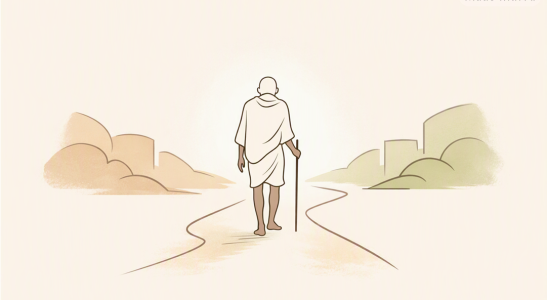
On Gandhi’s 157th birth anniversary, let us draw inspiration from the frail old man, clad in a white loincloth, walking barefoot through the blood-stained paths of Noakhali. More than a commemorative image, he represents a difficult discipline: the courage to enter an atmosphere poisoned by hatred, question the injustice, and confront evil without vilifying the perpetrator.
I couldn’t perfectly embody Gandhi’s discipline in the cafe. But I learned that I should resist the falsehood and the negative feelings toward the person repeating it.

In this time of hatred and anger, this is a timely post. Love it 💗
Thank you, Patrice. I am glad you enjoyed it.
Most surely did! 🤗