The Secret to Discipline? Trick Yourself.
“So tell me your secret,” I asked.
“There is no secret,” Anju replied, sipping her coffee. “Just that I stopped looking for motivation.”
I was puzzled. I expected her to educate me on a miracle diet. How else could she have lost so much weight in just two years?
“I relied on disciplined effort,” she continued, sliding her glasses up her nose.
Curious, I asked her to explain. She smiled with enthusiasm and, as the rain pattered outside, started narrating her weight-loss journey, with its ups and downs.
Anju’s story
Anju was worried about her weight since childhood. I have seen her try many exercise routines and diets to reduce the excess weight. But they never seemed to produce lasting results. The advice from elders and teasing from classmates only made things worse. The constant struggle was exhausting.
Some time ago, she realised that her issue was not knowing what to do, but losing motivation. She stopped waiting for motivation and began building habits that made discipline easier.
I was intrigued. Discipline, for me, was the eldest son of energizing motivation and jaw-clenching determination. I was even proud of memorising the American Psychological Association’s definition of self-discipline: the control of impulses in favour of long-term goals and the resolute adherence to a course of action. I thought I had the whole business of discipline figured out.
But Anju had a unique take.
She said what worked for her was not resisting temptation, but arranging life so that the better choice became easier. For instance, she understood that no amount of not looking, not smelling, and not thinking is enough to resist a gulab jamun, the syrup-soaked Indian sweet she loved. But choosing restaurants that don’t serve it works.
Anju’s Strategies
Her explanation reminded me of a striking observation from social psychologist Jonathan Haidt. In his book The Happiness Hypothesis, he compares our automatic and emotional instincts to an elephant and our conscious reasoning to its rider, or mahout. The rider may know where to go, but the elephant is much stronger and isn’t always easy to control. So the trick is to find ways to work with the elephant.
This is exactly what Anju did. Here are three strategies Anju used effectively.
She made the good choice easier
Anju found that waking up early to get to the gym was hard. Often, she woke up late and missed her workout. So she joined a gym along her route to work. Thus, on the way back, she could easily hit the gym.
The principle is simple: reduce friction. Want to read? Place a book near your bed. Want to eat healthily? Put your fruits and vegetables on the most visible shelf in the refrigerator.
She paired effort with pleasure
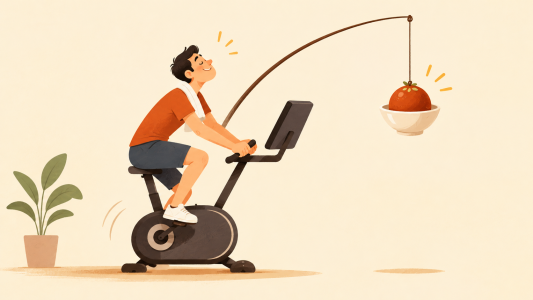
Anju loved watching long series. So she decided to watch them only while on her exercise bike. This gave her another reason to get on the bike. Anju read about this technique from the book Atomic Habits by James Clear.
The technique, known as temptation bundling, was studied by behavioural scientist Katherine Milkman and her colleagues. In an experiment, participants who could listen to tempting audiobooks only while exercising initially visited the gym 51% more often than the control group. The effect, however, declined over time.
If you have a temptation, you can bundle the difficult thing you want to do with it. For instance, decide that you will only listen to your favourite podcast while doing your dishes.
She planned for a bad day
The surest prediction we can make about life is that it never goes according to plan. So make a contingency plan.
When Anju couldn’t go to the gym, she did a 15-minute jump-rope workout instead. This helped to maintain the habit. Sometimes, doing a little is better than doing nothing. Once we stop for too long, getting started again can be much harder.
Outsmart the elephant rather than wrestling with it.
This doesn’t mean that Anju never faltered from her routine. Once she sprained her ankle and had to rest for days. She admitted that there were also days when she binge ate, got tired of working out, or just felt lazy. But the strategies made sure that a bad day didn’t become a bad month.
How it worked for me
Anju’s experience was personal, not a complete weight-loss programme or medical recommendation. But it made me realise that we can lure the elephant rather than drag it. I decided to try it with something I have been struggling with.
Months later, I messaged Anju and invited her to lunch. She agreed, and we met. As soon as we sat down, I told her how I started reading again because of her.
“Because of me?” She was surprised.
I took out my phone and showed her the picture of a book on my pillow. “Since the book was already there, reading a couple of pages before sleep seemed natural. In the last couple of months, I rescued two books that were home to the spiders in my bookshelf.”
“I am happy for you,” Anju said. “But I feel sorry for the spiders.”
