Let Love Breathe
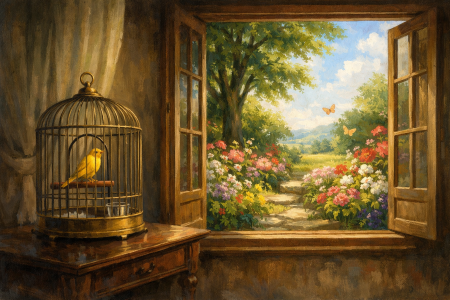
Once, an English news reporter came to interview Rabindranath Tagore.
The poet invited him in with great courtesy, and the interview began.
Amid the pleasantries, the interviewer noticed something peculiar.
He asked, “I’ve heard that you love flowers so much, but I don’t see any around.”
Tagore walked to the window and opened it; a beautiful garden lay in full bloom outside.
“Oh, I see!” the reporter said. “Why not pluck a few and place a vase of flowers in the sitting room? Then you can see them all the time.”
Tagore smiled and replied, “I love children too, but I don’t cut off their heads and keep them in bowls!”
Love and possession
I read this anecdote last week and had a hearty laugh. But later, like any good story, it made me think. My conclusions were uncomfortable because I, too, am someone who cuts the flowers and puts them in a vase.
Maybe this is an overlooked human flaw. The desire to own what we love is coded into our psyche. We believe this to be an expression of our love and care for them.
But is it really?
William James, the famous psychologist and philosopher, pointed out that “A man’s self is the sum total of all that he can call his.” That is, we measure our worth by the possessions we own, including relationships.
We see this all around. We cage birds, tame exotic animals, and hoard glittery things. But after a while, the birds try to break out of the cage, and things lose their glow, leading to chaos and depression.
I learned this firsthand when a close relationship suddenly disintegrated.
Recently, a loved one grew distant and then hostile. The abrupt transformation shocked me, but over time I came to accept what had happened. The journey from shock to acceptance was long and hard. But when that door slammed shut in my face, a sacred door opened quietly.
The reason
From a psychological perspective, people try to own and control things as an antidote to existential insecurity. Psychologists study this under the framework of Relationship-Contingent Self-Esteem (RCSE).
A 2026 study published in the International Conference of Psychology and Health (ICoPH) shows that when some individuals fail to regulate their own self-worth, they outsource that responsibility to their partner. They use this to stabilize their fragile egos.
Other psychological findings point to the anxious attachment style and the endowment effect. Most people fear abandonment. This anxiety forces them to control and interfere in the lives of loved ones: insisting on the way they should be, whom they should and should not talk to, and so on. Many others overvalue relationships—even toxic ones—because of the time and effort they invested. Hence, they cling to it.
Is this love? Hardly.
From my experience, I’ve realized that I don’t have to cling in order to express love. I can let go and still be loving. This gave me great freedom and emotional maturity.
In fact, in an attempt to preserve the beauty and presence of what we love, we often destroy the very freedom and vitality that made it beautiful in the first place.
Letting go
Letting go is painful not because we miss closeness, but because we must cut away the clingy part of ourselves.
When we decide to let go of our sense of ownership, we move closer to unconditional love. Spiritual teachers throughout the ages, including Jesus, Buddha, and Muhammad, urge us to live and love without attachment. Maybe that’s the path to real spiritual growth.
This may redefine our social constructs of love. But if it frees us from the shackles of emotional hurt and leads to unconditional love, won’t that be liberating?
So the next time you try to micromanage your loved one, pause and look inside yourself. Is your intention coming from pure love or insecurity?
If you are truly loving, let them be free. They may appreciate it, and may even reciprocate. Your relationship will then bloom with unconditional love.
Let the garden stay outside the window; let love breathe.

That is a really beautiful and thought-provoking perspective. It’s so easy to mistake attachment for love, but you’re right—true freedom is such a gift to give someone. That “letting the garden stay outside the window” line is such a powerful way to put it! Thanks for sharing this; definitely gives me something to reflect on today.
Thank you for taking the time to read and comment. Much appreciated.
Such a beautiful reminder—true love really is all about letting people be free to grow.
Thank you!
Thank you so much for showing us, once again and with such clarity, a path of spiritual growth. Your reflection is powerful because it is both profound and seemingly simple, for it is very difficult to extend your hand without smothering the bird and have it choose to stay . As always, your reflection will make us think and act, to improve in the most important aspects of our lives.
Greetings from Mexico.
Thank you Raul Sensei. It is such an honor to know that you benefitted from my humble words. Hope you are doing well.
I appreciate this post and resonate with much of it As far as the flowers. I think it’s a bit different when it comes to cutting them to bring inside. They are here to bring joy and some are meant for cutting so that joy can be spread. Why would I cut myself off from that? So in this case for me it’s not so much about holding on to something it’s about not allowing myself to receive joy, love, beauty of nature that it’s offering.
I think my motive and purpose are the things I need to examine in any relationship.
I agree. It seems to me that it is more about perspective than anything else. I admitted that I used to be the person who loved to see a beautiful bouquet or a vase. But now I enjoy seeing them thrive in their mother plant.
Thank you for taking the time to read and comment.